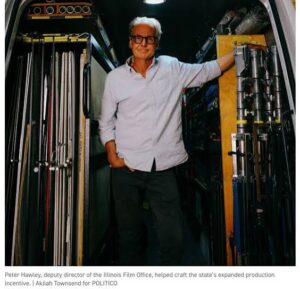
In the Spring of 2026 Illinois became the first state in the country to offer a tax incentive for productions that make a certified green (sustainable) film production. This was a long time coming and something I am very proud of. I say this in all modesty, this was my idea. Politico did an article about it, see the link, and the writer said to people he interviewed, “you know this guy (me) is the architect of green production.” That was nice and there was a nice photograph.
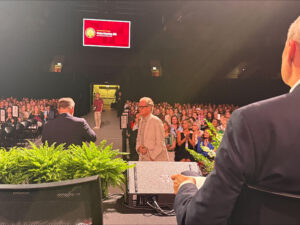
In mid-June, 2026 I was informed by Loyola University that I won the Magis Award, a university-wide teaching award. I was honored, and at the same time humbled. It feels like a lifetime achievement award (a nice way to say I am old.) But as I think about it, what is wrong with being recognized for a life of teaching.
In the fall of 2008 I produced a nice (in my humble opinion) short film written and directed by my friend Harper Philbin. The film was in some festivals, and we had a blast making it. In fact it was the last time I shot real film!
Until recently the film only lived on DVD, but I found a file and now can add it to the archive. Please enjoy.
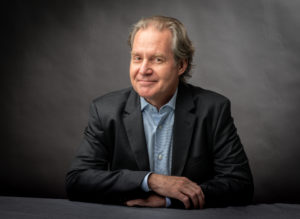
Well, lookie there, I am all dressed up (though I think I had jeans on below the frame). Thanks to my friend Chuck Cherney for taking this. On May 1, 2019 I became the director of the Illinois Film Office. I oversee the $500 million and growing Illinois Film Business. It’s been a great six months, and we must be doing something right because productions keep coming to Illinois, and we are taking shows from Georgia.
My office really oversees the Illinois Film Tax Credit Incentive- in short %30 on your Illinois spend on productions. Projects 30-minutes and shorter must spend $50,000. 30-Minutes and longer must have a $100,000 minimum spend. This is why Illinois gets so many TV series, and I think it is a haven for Independent Filmmakers.
Among my favorite projects for Wiss Janney Elster was shooting at the historic Salk Institute in LaJolla, CA. I did this project with my Crosstown Productions partner, Dan Lerner. The D.P. was from my school in L.A., Columbia College Hollywood, Charlie Rose. The header photo on the peterahawley.com website was taken by the WJE, client Jeff Caldwell, and it’s of me, Dan and Charlie at Sunset on one of the production days.
This week on Teaching in the Arts, Tom Durkin, the legendary horse race announcer. Close listeners to the podcast will know my love of horse racing, and especially horse race announcers. You have also heard me talk about making a documentary film where I interview race announcers, and will call a race myself- good, bad, or otherwise.
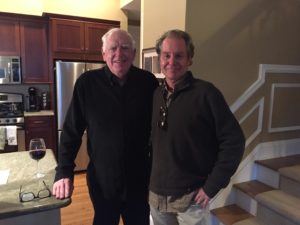
That brings me to this week’s episode. In November, I traveled to Saratoga Springs, NY where Tom Durkin was kind enough to allow us into his home for an interview. In my film, Tom acts as my mentor- giving me tips, pointers and sharing his knowledge. After I call my race he will review me. But in the film, I will only use a small portion of my interview with him, so I have decided to run the interview as an episode of the podcast. It fits because in the interview, Tom teaches me.
He not only gives me valuable pointers on how to call a race, but we talk about the hard parts- the stress of the job, how he used hypnosis to help him out, how his career began on a lie (told by someone else). And he talks openly about the 2009 Kentucky Derby, where he was caught by surprise with the late charge of Mine that Bird. Watch for yourself here- the final 25 seconds of the race, and listen to Tom and I discuss.
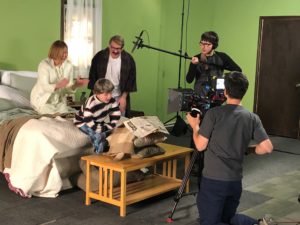
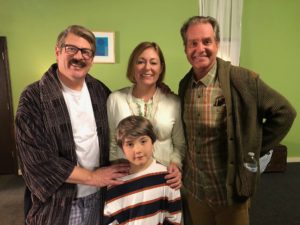
As part of my film I shot a recreation- something I have wanted to do, but never had the opportunity. On Saturday Dec. 1, I recreated Sunday May 2, 1971 as I jumped into my parents bed and “called” the Derby from the day before. Here are some production stills, but thanks to my friend Amy Rising for playing my mom, Isaac Zumann as Peter, and Keith Kelly as my dad. And thanks to all my great crew, Vedran Residbegovic my D.P., Killian Heilsberg (guest number 3 on Teaching in the Arts), Betsy Finn my hair and make up artist, and my pal Normann Pokorny who came along as support, and who took all these pictures. It was a great day, and when my film is complete, you will see the recreation- 4K HD looking like 16mm and 8mm film.
Here are some photos from the shoot.
And if you want to see a snippet of my film, and an announcer in action, here is John Dooley, announcer at Arlington International Race Course and the Fairgrounds in New Orleans in action.
This is the last episode of Teaching in the Arts for the calendar year. Winter break time, back in January with all new episodes. Listen to me and Tom Durkin here:
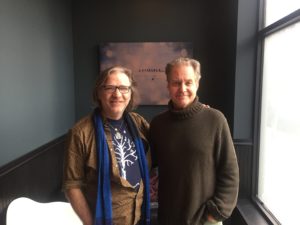
The Old Town School of Folk Music is going through some difficult times. Enrollment is down, teachers are unionizing, students and teachers are both feeling changes happening without being informed or consulted. My guests this week are John Mead, a teacher at the Old Town School since 2001, and Rich Gordon, a longtime student, and one of the organizers of the Save Old Town School movement.
Here’s some background:
In October the administration at Old Town School announced they were selling the school’s building at 909 W. Armitage, which has served as the school’s historic home for more than 50 years. The next day Save Old Town School was founded. Since then a change.org petition has more than 8,000 signatures and last week there was an Old Town School board meeting where teachers and students spoke to the board and pushed for change.
I will let John and Rich tell the story from here, but here is a link to their website and the Change.org petition.
Also, you will hear John mention the Bruce Springsteen Ensemble. They are playing tonight, Dec. 3, 2018 at Martyrs here in Chicago, check them out if you can.
I have done a lot of work for Wiss Janney Elstner, but in 2006 I was able to produce a film for their 50th anniversary. It screened at the Museum of Science and Industry in May 2006. Here is a brief sample of the film, originally 60 minutes long.
This was my one and only foray into Infomercials. It was a lot of fun- and a lot of work. I wrote and directed and co-produced. There was a lot of narrative work so that was fine. I guess that’s why we call it an archive- to collect the materials.
Denny Dent, and his wife Ali, were key players in my development as a filmmaker. Ultimately I filmed him 4 times, all with my Northwestern pal and DP on Victimess Crimes, Stephan Fopeano shooting.

 Well, lookie there, I am all dressed up (though I think I had jeans on below the frame). Thanks to my friend
  This week on Teaching in the Arts, Tom Durkin, the legendary horse race announcer. Close listeners to the podcast will know my love of horse racing, and especially horse race announcers. You have also heard me talk about making a documentary film where I interview race announcers, and will call a race myself- good, bad, or otherwise.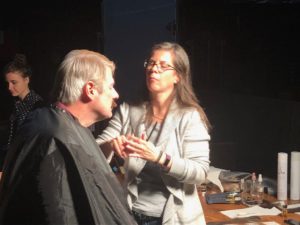
 The Old Town School of Folk Music is going through some difficult times. Enrollment is down, teachers are unionizing, students and teachers are both feeling changes happening without being informed or consulted. My guests this week are John Mead, a teacher at the Old Town School since 2001, and Rich Gordon, a longtime student, and one of the organizers of the Save Old Town School movement.
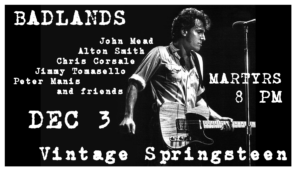 Also, you will hear John mention the Bruce Springsteen Ensemble. They are playing tonight, Dec. 3, 2018 at Martyrs here in Chicago, check them out if you can.


